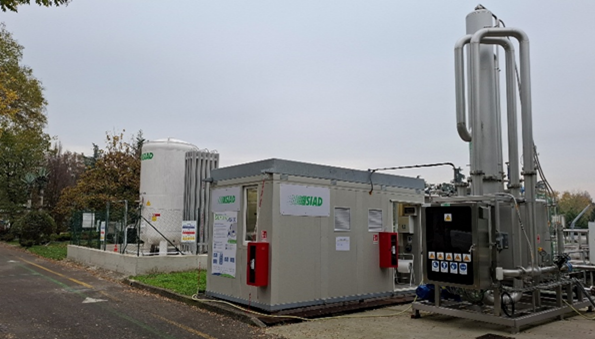
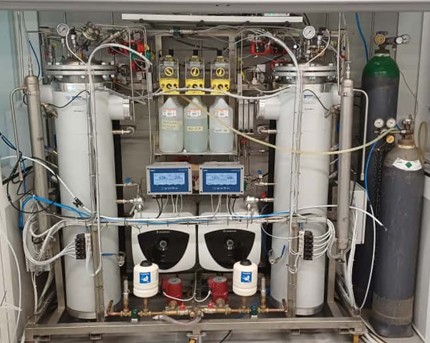
Experiments on the Ex-Situ Biomethanation (EBM) plant are progressing effectively. Both reactors, one using a membrane for gas diffusion (attached biomass, reactor A) and the other employing diffusers (suspended biomass, reactor B), have been continuously in operation for over three months. Different venting patterns are being cyclically tested in Reactor A to maximize process efficiency, while various H2/CO2 ratios are tested in Reactor B to enhance hydrogen consumption. Hydrogen transfer efficiency and conversion efficiency are regularly monitored, along with COD and carbon balance, in order to optimize the reactors’ operational parameters. Preliminary results suggest that reducing the venting opening time from minutes to seconds would improve hydrogen transfer efficiency and enhance the overall system performance.
The ozonolysis plant was operated continuously until the end of April with a specific ozone dosage of 10-20 gO3/kgVS, and then stopped in order to have comparison data (negative control) and to make a general maintenance of the contact reactor. The maintenance regarded principally operation to solve clogging and corrosion problems on hydraulic circuit, due to fibrous content in the sludge, and to optimize gas transfer at high flows.
The operating data of the sludge line with and without ozonolysis in operation were processed for a first assessment of the effect of sludge pre-treatment with ozone on the full-scale anaerobic digestion and, in particular, on biogas production and on the solids content of the sludge disposed of.
The data show how treatment with ozonolysis does not express inhibitory effects on the anaerobic digestion process, keeping constant the methane content in biogas and determining a containment of H2S concentration. The digested sludge maintains unchanged its specific methanogenic activity (SMA) and does not show chemical-physical variations unless a partial increase in the content of dissolved substance in terms of COD and Organic Nitrogen due to the dissolution effect of ozone on solid sludge content.
The data collected at the tested ozone doses do not yet show an effect on biogas production, for this reason the research now is proceeding by operating ozonolysis plant at higher doses of 30-50 gO3/kgVS. BMP tests carried out in July on sludge treated with these higher doses confirmed the increase in biogas production of +20/25% in sludge treated respect the untreated sludge. The continuous operation of the plant at these dosages may allow to confirm the increase of biogas production at full-scale too and to quantify the minimization of sludge disposal.
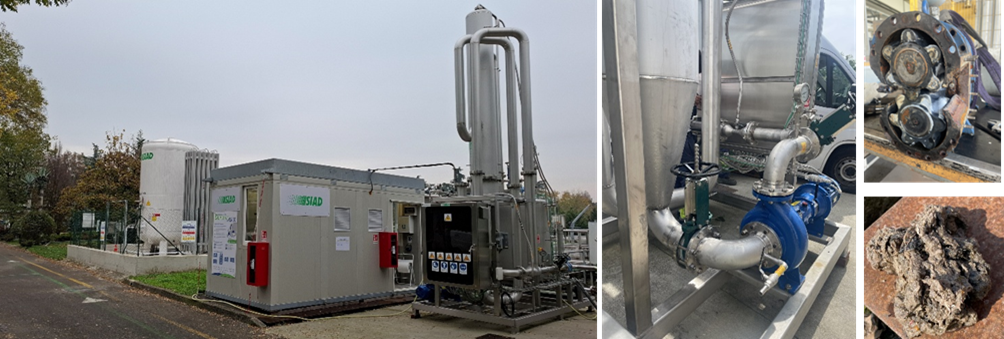
Ozonolysis installation (oxygen tank, ozone generator container and contact reactor); hydraulic optimization; feeding pump maintenance; sludge fibrous material in the hydraulic circuit of the plant.