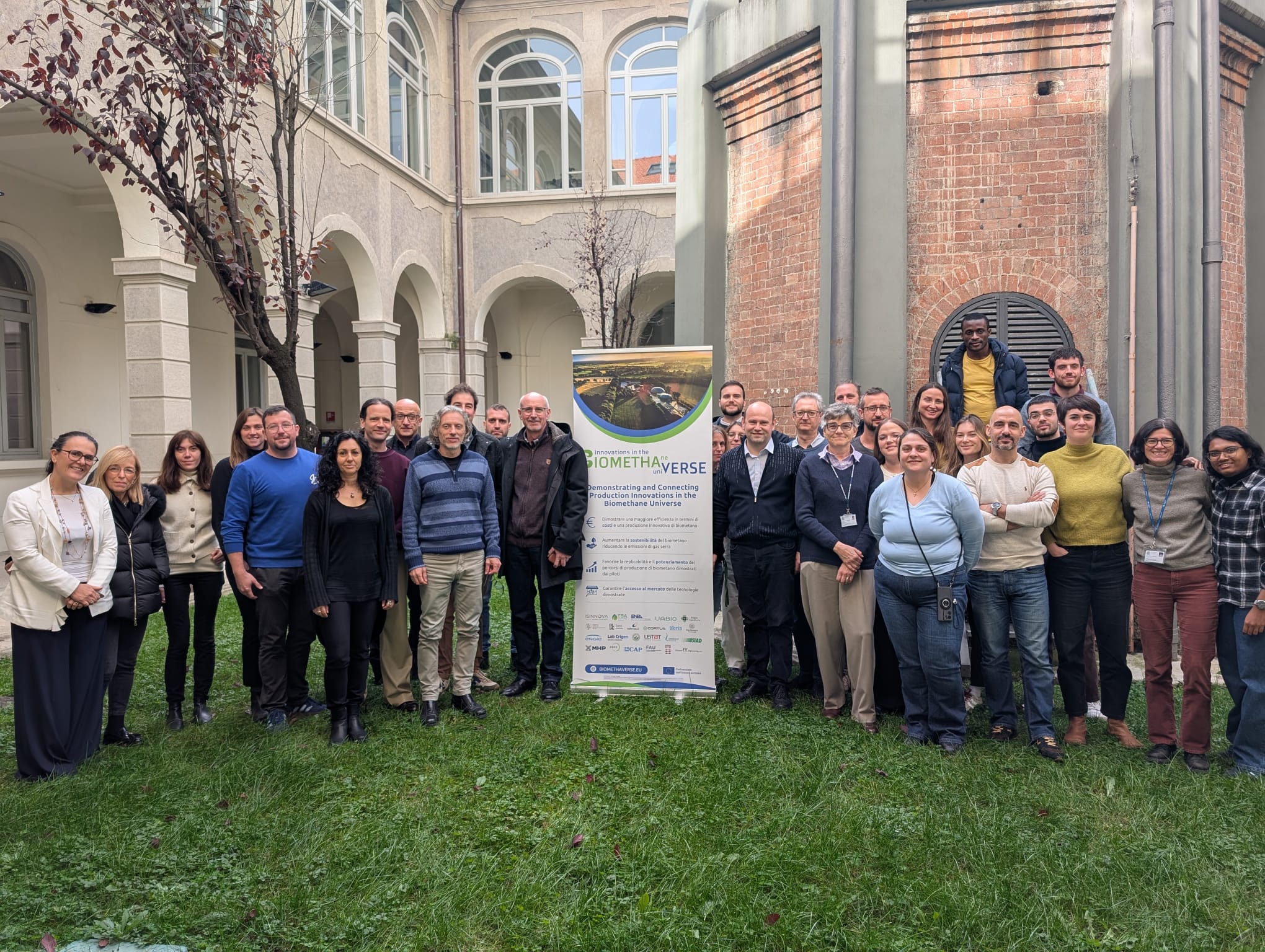
BIOMETHAVERSE partners met in Milan on 25–26 November 2025 for the project’s latest General Assembly and Technical Workshop, hosted at the Politecnico di Milano. Partners participated both in person and online to review progress, assess demonstration activities and strengthen ongoing collaboration.
Day 1 opened with a welcome from the coordinator (ISINNOVA) and an update on the status of the amendment, along with preparations for the upcoming reporting cycle. All Progress Report content has been completed offline and will be uploaded as soon as the amendment is approved and the portal reopens.
An overview of the general project progress confirmed that coordination continues smoothly, with major deliverables planned in early 2026 and the next consortium meeting foreseen for summer 2026, likely including a site visit and stakeholder workshop.
All leaders provided detailed progress reports on their respective work streams:
WP2 – Demonstration of Innovative Biomethane Pathways
Demonstration sites are progressing into their most intensive phase. Some delays remain due to procurement and integration issues, and a reinforced monitoring and reporting approach has been introduced.
WP3 – Assessment and Optimisation
Techno-economic, environmental and social assessments are advancing. Early results highlight the influence of hydrogen electricity demand and feedstock characteristics on sustainability outcomes. Further measurement campaigns are planned for 2026.
WP4 – Replicability, Markets and Policy
Policy recommendations are being developed alongside market penetration analysis and investor-focused decision tools. Engagement with replication sites is underway, with a shortlist expected by the end of 2025 and a workshop planned for June 2026.
WP5 – Dissemination, Exploitation & Communication
Strong outreach performance continues, including high newsletter engagement and ongoing work on demo videos and international dissemination activities. Workshops at national and international levels are planned for 2026, alongside continued exploitation support.
The day concluded with a visit to POLIMI’s laboratory facilities and an official dinner in Milan.
Day 2 was devoted to updates and progress from BIOMETHAVERSE’s five demonstration sites:
Italy – EBM: Ex-situ Biological Methanation & Ozonolysis
The ozonolysis pilot has been operating continuously with strong hydrolysis benefits and methane yield improvements. The upgrading and microalgae pilots continue optimisation, and co-digestion has entered its start-up phase.
Sweden – ESB: Ex-situ Syngas/Biogas Biological Methanation
Extended successful operation was achieved before the installation required relocation due to site unavailability. A new location is being finalised pending amendment approval.
France – EMG: Electro-Methanogenesis Pilot
The pilot is fully installed and commissioned at a new site in Evron, with initial operational issues resolved. Data collection is underway to support techno-economic analysis and scientific publications.
Ukraine – IBM: In-situ Biological Methanation
Despite challenging local conditions, the pilot has been commissioned and is delivering strong performance, with hydrogen dosing significantly increasing methane yields.
Greece – ETM: Ex-situ Thermophilic Methanation
Installation and integration are close to completion. Initial commissioning is planned for early 2026, followed by full pilot operation and data collection.
Outlook and Key Actions for the Months Ahead
Overall, the Milan General Assembly reaffirmed the consortium’s shared commitment to delivering innovative biomethane pathways that can be successfully scaled and replicated across Europe. Over the next phase, the consortium will prioritise the swift submission of all required reporting as soon as the amendment is validated, while maintaining strengthened monitoring of activities across the demonstration sites.
Pilot data will continue to feed into modelling and sustainability assessments, supporting robust analysis for future decision-making. Work will progress on the selection of replication sites and refinement of policy-related outputs. At the same time, dissemination activities will remain active, including the production of demonstration videos and the organisation of workshops to engage stakeholders at national and international levels.