
The integration of innovative technologies into wastewater treatment plants (WWTPs) drives the transition toward circular economy and renewable energy production. Recent milestones from the Italian pilot-scale operations highlight significant progress in sludge pretreatment, gas upgrading and microalgae-based co-digestion.
Ozonolysis and Sludge Pretreatment
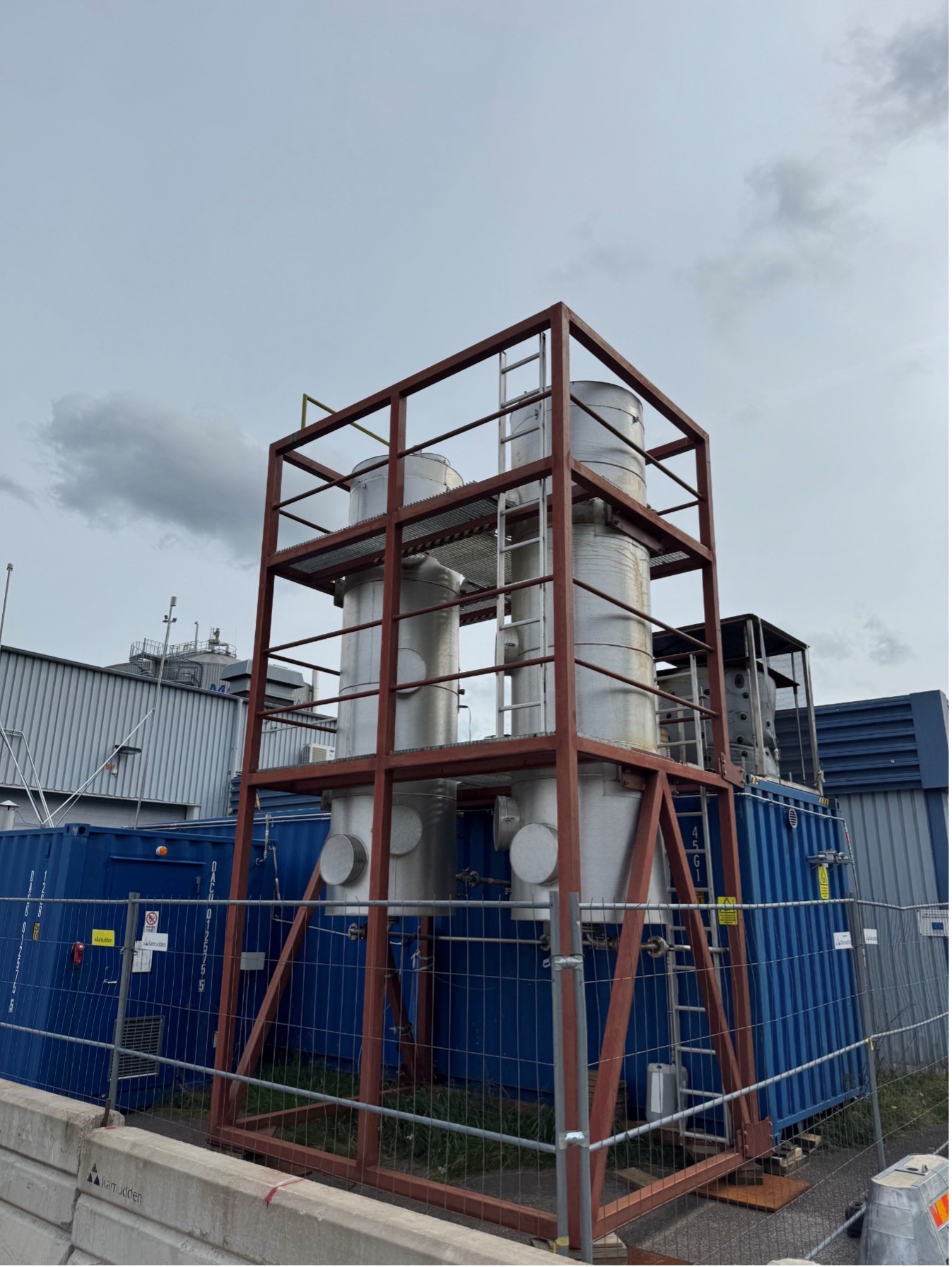
The ozonolysis pilot plant demonstrated robust performance during a continuous run from September to December 2025, providing crucial data at higher net ozone dosages (25-45 gO₃/gVS). Results confirmed that the process does not adversely affect the anaerobic digestion biomass, as the hydrolytic (SHA), the acetogenic (SAA) and the methanogenic (SMA) activities remained stable. While preliminary evidence continues to suggest an increase in methane production, further trials are underway to consolidate these findings. Following a brief period dedicated to technical maintenance on the recirculation and discharge lines, the plant resumed continuous operation in mid-April 2026. The upcoming commissioning of the second real-scale digester will soon allow for a side-by-side comparison to better quantify the impacts of ozonolysis on both methane yields and sludge reduction.

Figure 1: The ozonolysis plant installed at the Bresso WWTP; from left to right: the oxygen storage tank, the ozone generator and the contact reactor.
Ex-situ BioMetanation (EBM) Readiness
In parallel, the Ex-situ BioMetanation (EBM) plant was successfully restarted in March 2026. The two-month scheduled stop allowed comprehensive maintenance and the optimization of cabling and electronics. These adjustments were vital in preparation for the system’s relocation to the Bresso WWTP, scheduled for the upcoming weeks. Furthermore, the capacity of the system has been enhanced with the installation of the second membrane in Reactor A, which will enable the investigation of biomethanation dynamics under a novel operational configuration.
Microalgae Integration and Co-Digestion Synergy
Complementing these efforts, the integration of microalgae cultivation into WWTPs offers a promising pathway for waste valorisation. Utilising the liquid fraction of digestate as a nutrient source, the pilot-scale raceway reactor has maintained high operational stability over the last three years from spring to autumn, achieving an average productivity of 11.3 g TSS/m²/d with remarkable nitrogen (89%) and phosphorus (56.4%) removal efficiencies.
Research into co-digestion has yielded encouraging results: while microalgae (MA) and waste sludge (WS) showed comparable individual methane yields, semi-continuous tests revealed that microbial adaptation can enhance yields to 166–188 NmL CH₄/g VS, confirming a better stability of the process and the potential to enhance the WWTP biogas yield via co-digestion of the on-site production and co-digestion of microalgae.
Notably, ozone pretreatment of microalgae has proven effective in disrupting rigid cell walls, increasing methane yields by up to 18% in BMP tests.
Semi-continuous trials confirmed these results with average methane yields of 208 ± 8 NmL CH₄/g VS (WS + ozonated MA) vs. 186 ± 7 NmL CH₄/g VS (WS + untreated MA), with digestate showing elevated ammoniacal nitrogen and conductivity, and reduced volatile solids (VS), indicative of superior degradation.


Figure 2: Picture of the pilot-scale co-digester plant inside a container (left). PLC monitor showing operative parameters (right).
Finally, the pilot-scale anaerobic co-digestion plant (Figure 2 left) is now fully operational in steady-state conditions. The setup includes a temperature-controlled feeding tank to prevent pre-fermentation, an automated gas counter, and a centralized PLC (Figure 2 right) for real-time monitoring of operative parameters. This infrastructure is now ready to validate the integration of raceway-produced microalgae with waste sludge at scale, paving the way for comprehensive techno-economic assessments and future industrial applications.